

Our Book Club meets in function of the calendar of all participants, aiming to provide for those who prefer online and those looking for in-person face-to-face discussion All are welcome, wether you've barely cracked the book or already broken the binding from rereading it. And we ask that you help us to keep the discussion on track, sticking to the theme of the books that we've chosen.
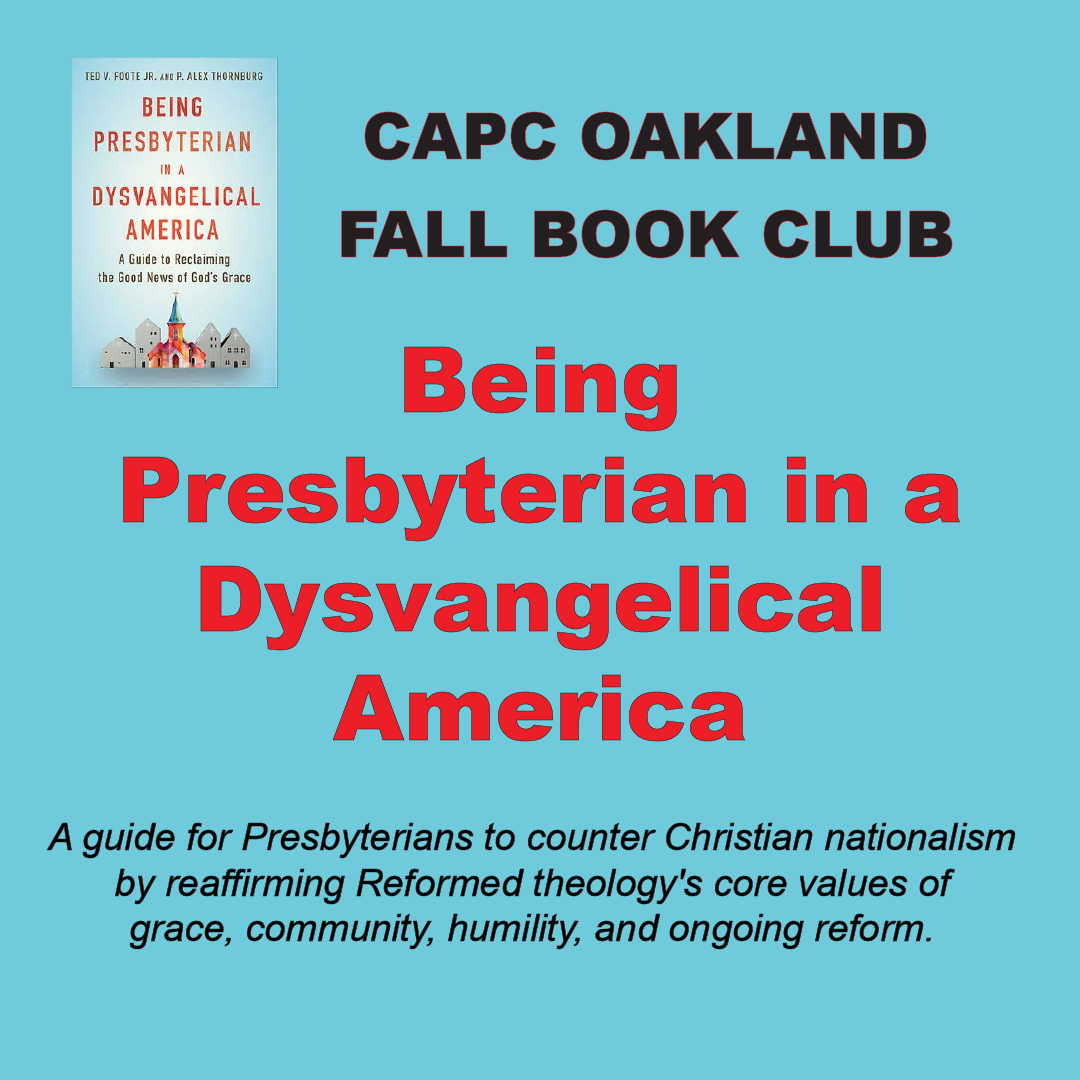
Beginning in October we are reading the book Being Presbyterian in a Dysvnagelical America over an 8 week period. This means that we’ll discuss one chapter each week. Written by two pastors, the book is profoundly theological and also quite accessible (in order words it’s not written for PhD types for other PhD types). The book is a guide of sorts for Presbyterians to counter Christian nationalism by reaffirming Reformed theology's core values of grace, community, humility, & ongoing reform. It’s a great exploration of Reformed (Presbyterian) Theology.
We’ll have 3 meetings a week starting October 4th:
Sundays in person from 12-12:30pm at church
(October 4, 11, 18, 25 and November 1, 8, 15, 22)
Wednesdays at 12-12:30pm on Zoom.
(October 7, 14, 21, 28 and November 4, 11, 18, 25)
Wednesdays at 6-6:30pm on Zoom.
(October 7, 14, 21, 28 and November 4, 11, 18, 25)
To Join the Online Book Club Sessions on Zoom CLICK ON THIS LINK:
Meeting ID: 546 703 271
Passcode: 5951
Dial by your location
+1 669 900 6833
Chapter Helps CLICK HERE
Other RESOURCES FOR engaging the ideas of this book
Being Presbyterian in a Dysvangelical America Information from the PC(USA) Store [LINK]
Comprehensive Narrative Summary of the Book LINK to thirdwell.org blog
Videos on Each Chapter with the Authors and other Helps organized by Chapter
Introduction
Definition of Key Terms:
Presbyterianism means affirming three points: (p 2)
God’s grace and the claims of God’s grace are the primary charactericstic of God’s interactions wih the world.
When we experience this unmerited grace, we live in gratitude and awe.
Community is central for our shared human well-being.
Evangelical: essentially means sharing the good news (gospel - “evangel” in Greek) p. 3. It can also mean many other things and perspectives. This is how the authors define the book in their discussion.
Dyvangelical: a theology that is distorted, dysfunctional, and dystopian, turnign the good news into the opposite of what it means to be evangelical. p. 3
The Reformed tradition is the theological family to which Presbyterianism belongs. The Reformed tradition traces its roots to a French lawyer named John Calvin, who had fled religious persectuion in France fo the safety of Geneva and Switerzerland, in the tumultuous sixteenth century. Many strands of Christianity - from Lutherans to Anabaptists to Anglicans -were born in the rich and complex movement called the Protestant Reformation. (4-6)
The Reformed Tradition:
sees the nature of God (and thus reality) as grace-ful. Grace is an assertion that life is a gift given freely and with no strings attached.
building on the asssertion that grace undergirds reality, views the universe as under the reign of God.
claims that we are “reformed and always reforming.” There is humility to this approach of always seeking truth even when that turh challenges our basic assumptions.
Chapter 1
Is the Bible literal and innerant? And if not, does it have any authority?
How do we interpret the Bible?